

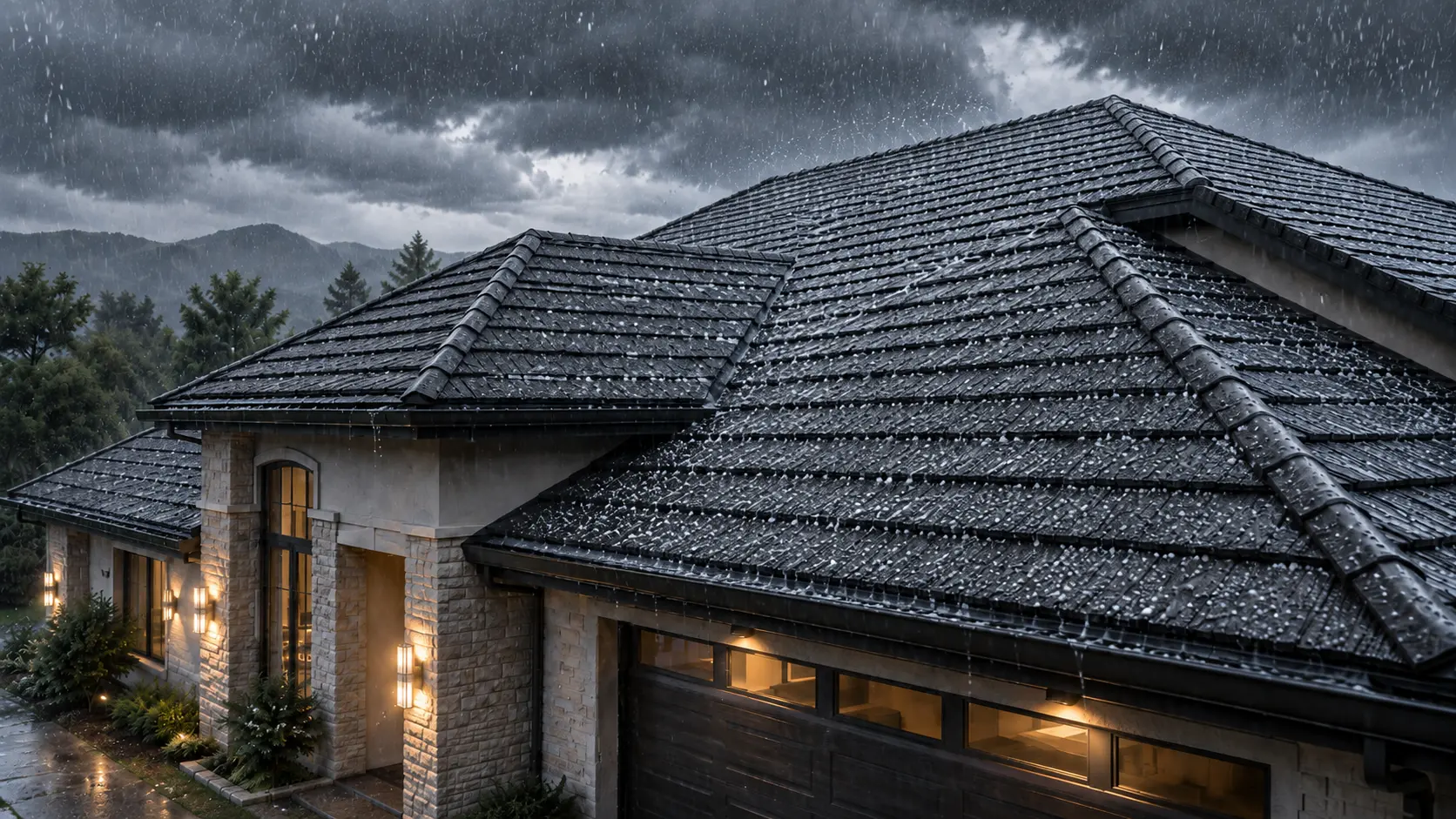
Hail is one of the most expensive threats a roof faces, causing billions of dollars in property and crop damage across the U.S. every year. If you live where storms roll through each season, choosing a hail-resistant roof is one of the smartest long-term investments you can make. This guide explains what hail resistance actually means, how the Class 4 rating works, and which hail-resistant roofing materials hold up best when the sky turns violent.
What Is a Hail-Resistant Roof?
A hail-resistant roof is one built from materials tested to absorb the impact of hailstones without losing their ability to keep water out. Resistance is never about a single feature. It depends on the material and its thickness, the product's design and profile, the quality of the installation, the condition of the roof deck and underlayment, and — critically — the size, density, and speed of the hail itself.
People often search for a hail-proof roof or hail-proof roofing, so it's worth being precise: no roofing material is truly hail-proof, and any product sold on that promise is overstating what a roof can do. Even the toughest products can pick up cosmetic damage in a severe enough storm. The honest, verifiable measure is hail resistance — how well a roof survives an impact and keeps doing its job — and the clearest proof of it is a documented Class 4 (UL 2218) rating. That's the standard credible manufacturers point to instead of vague "hailproof" claims.
What Does a Class 4 Hail Rating Mean?
In North America, impact resistance is measured mainly by UL 2218, the impact-resistance standard for prepared roof covering materials. It's a controlled "steel ball" test that grades how well a roof covering survives a simulated hail strike.
The test uses four classes, each with a larger ball dropped from a greater height:
- Class 1 — a 1.25-inch steel ball dropped from 12 feet
- Class 2 — a 1.5-inch ball from 15 feet
- Class 3 — a 1.75-inch ball from 17 feet
- Class 4 — a 2-inch ball from 20 feet, the highest rating available
Each spot is struck twice, and the covering is then inspected. The pass/fail question is whether the material cracks, splits, or ruptures through to the underside — in other words, whether it loses its ability to shed water. Cosmetic dents, scuffs, or granule loss on the surface do not count as a failure. This UL 2218 roof rating is sometimes referred to simply as a roof's hail rating.
This is the key to reading a Class 4 hail rating correctly. The rating shows that a product survived a standardized laboratory impact. It does not guarantee zero damage in every storm. UL itself notes there is no established direct correlation between steel-ball results and the behavior of real hailstones across all conditions, and real-world factors like material aging, temperature, roof slope, and installation quality all influence field performance.
A Class 4 rating is the right minimum to look for — but not every Class 4 product is equal. The rating certifies that the covering passed a standardized impact on the day it was tested; how well a product holds that performance over 20–30 years depends heavily on the base material. This is where roofing materials diverge sharply, as the sections below show.
One practical upside is financial. Many home insurers offer premium discounts for a documented Class 4 roof, though the amount varies widely by carrier and state. Keeping your product's test records on file — the Class 4 impact-rating documentation — makes that easier to claim.
What Are the Best Roofing Materials for Hail?
The best roof material for hail balances four things: impact resistance, durability, cost, and how the material behaves after repeated storms. Independent research from the Insurance Institute for Business & Home Safety (IBHS) on hail impact resistance shows that real-world performance varies widely even among products marketed as impact-resistant — so the label alone isn't enough.
Asphalt Shingles
Asphalt is the most common roofing in the U.S., and some lines carry a Class 4 rating — the best hail-resistant shingles, such as GAF Timberline ArmorShield II, Owens Corning Duration STORM, and CertainTeed impact-rated lines, genuinely pass the test. The catch is durability over time: asphalt loses granules and its mat grows brittle with age, and IBHS testing found most impact-resistant shingles rated only "good," none "excellent." A Class 4 asphalt shingle is most protective when new and least protective years later — often exactly when major hail arrives. The rating matters, but on asphalt it fades; on a rigid base like stone-coated steel it lasts.
Metal Roofing
Metal offers high impact resistance and a long service life, and many systems carry a Class 4 rating. Steel and aluminum flex and disperse impact energy rather than shattering, which is why they perform so well in hailstorms. Very large hail can leave cosmetic dents, but a quality metal roof typically keeps shedding water regardless. Unlike asphalt, rigid metal systems hold their Class 4 performance across the roof's service life rather than declining with age.
Clay and Concrete Tile
Tile is durable, fire-resistant, and attractive, but it's brittle. Large hail can crack or chip individual tiles even when the overall system is otherwise robust. The upside is that damaged tiles can usually be replaced individually rather than re-roofing. Homeowners who want the tile look without the brittleness often turn to stone-coated steel, which reproduces the profile over a flexible steel base that doesn't fracture on impact.
Composite / Synthetic Roofing
Engineered polymer products imitate slate or shake, and many are rated Class 4. They're lighter than tile, offer solid impact resistance, and make a credible hail-resistant material — though cost and long-term field track records still vary by manufacturer. At a comparable Class 4 rating, steel-based systems tend to offer a longer and more established real-world track record.
Are Metal Roofs Hail Resistant?
Yes — a metal roof is among the most hail-resistant options available. Metal roof hail resistance comes from the way the material behaves on impact: instead of resisting through sheer mass, panels flex slightly and spread the energy of a hailstone across the surface, then return to shape.
The distinction that matters most is cosmetic denting versus functional damage. A dent that doesn't breach the panel or its coating is purely aesthetic — the roof still does its only real job, which is keeping water out. Functional damage, such as punctures, split seams, or coating failure, is what actually threatens the building. Most quality metal roofs resist functional damage from typical hail even when they show a few surface marks, which is why metal roofs and hail are so often discussed together as a good match.
How well any metal roof holds up to hail depends on the gauge (thickness), the panel profile (deeper profiles and interlocking systems disperse energy better), the base material, and correct installation over a sound deck. A hail-resistant metal roof is ultimately a system, not just a panel. Stone-coated metal roofing is a particularly strong performer here: the stone coating adds a protective wear layer and helps mask minor cosmetic marks, while the steel underneath delivers the structural strength that keeps the roof watertight.
What Is a Class 4 Metal Roof?
A Class 4 metal roof is one whose covering has earned the top UL 2218 rating — it survived two strikes from a 2-inch steel ball without cracking through to the underside. For homes in hail-prone regions, this is the benchmark to look for, because it certifies the covering against the most severe impact energy the standard tests for.
This is also where the base material becomes decisive. A Class 4 rating on a material that keeps its integrity for decades — such as stone-coated steel or quality metal — delivers what the rating promises across the life of the roof. A Class 4 rating on a material that degrades with age delivers it mainly when the roof is new. The rating is the starting point; the material determines how long it lasts.
Novatik stone-coated steel systems are tested to a Class 4 (UL 2218) impact rating, which is why they're a natural fit for areas that see hail year after year. For homeowners who want the same performance in a cleaner, panel-style look, Novatik's modular metal roofing offers another Class 4 route to the same underlying durability.
Metal Roof vs. Shingles for Hail
Both can be excellent hail-resistant choices. Impact-resistant shingles win on upfront cost and are easy to source, which makes them a sensible pick for many budgets. Metal wins on longevity and on how it recovers after a storm — it's far less likely to need replacement in the years following repeated hail. Neither is hail-proof, but the Class 4 version of either material meaningfully lowers your risk of a leak and an insurance claim.
How to Protect a Roof From Hail
You can't stop hail, but you can stack the odds in your favor:
- Choose impact-rated roofing. A Class 4 covering is the single biggest factor in how your roof survives a storm.
- Insist on correct installation. Fasteners, deck condition, and underlayment all affect real-world performance — hire a qualified installer.
- Inspect regularly, and after every severe storm. The National Weather Service classifies a thunderstorm as severe once hail reaches one inch in diameter, and large hail can fall faster than 100 mph, so damage is possible even when a roof looks fine from the ground.
- Repair promptly. Address damaged flashing, vents, and any compromised elements quickly to stop small problems from becoming leaks.
- Keep your documentation. Filing your roof's impact-rating documentation with your records makes insurance discounts and claims far simpler.
What Is the Best Roof for Hail Storms?
There's no single answer that fits every home. The best roof for hail storms depends on your budget, your climate, your home's design, and the level of durability you actually need. Impact-resistant asphalt shingles are the cost-effective choice for many homeowners; tile and composite each have their place.
But for regions that see regular, damaging hail, metal roofing — and Class 4 stone-coated steel in particular — stands out as one of the strongest and longest-lasting options available. That's why it's a common choice for hail-resistant metal roofing in Texas and other high-hail states, where roofs are tested season after season.
The bottom line: no roof is truly hail-proof, but a Class 4 system built on a material that holds its performance gives you the best combination of impact resistance and long-term value — a roof that keeps doing its job long after the storm has passed. Explore Novatik's full range of Class 4 metal roofing systems to compare profiles.
If you're also weighing broader climate factors like wind, heat, and coastal exposure, see our guide to the best roofing materials for Florida homes.