

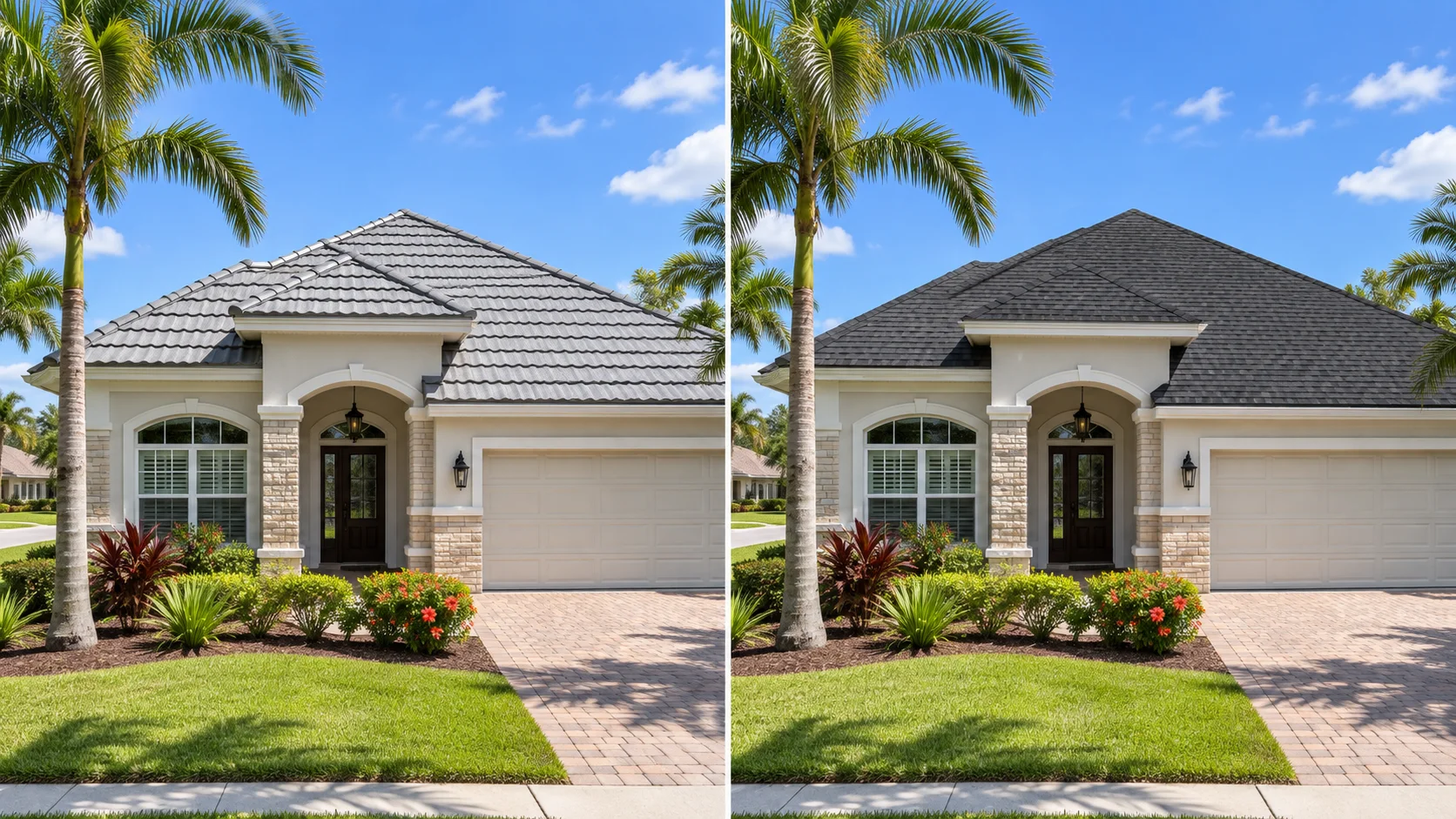
If you live in Florida or Texas, the question makes sense. Metal feels hot in the sun, so it is easy to assume a metal roof will turn your attic into an oven.
The short answer: no. A well-designed metal roof does not make a house hotter than asphalt shingles, and in hot climates it can help reduce heat gain and keep a home cooler. What matters is how the roof reflects sunlight, how efficiently it releases heat, and how much of that heat reaches the attic.
Here is how metal roofing compares with asphalt shingles in hot weather, and what to look for when choosing a roof for your home.
Metal Roof vs. Shingles in Hot Climates: Which Stays Cooler?
Both roofing materials face the same sun. The difference is how each surface absorbs, reflects, and transfers that solar energy.
How Asphalt Shingles Absorb Heat
Asphalt shingles are made of an asphalt-saturated mat covered in mineral granules, and conventional dark shingles absorb most of the sunlight that strikes them. In research at Oak Ridge National Laboratory, the asphalt shingle roof used as a control had a solar reflectance of roughly 9%, meaning over 90% of incoming solar energy was absorbed.
Shingles are also installed directly on the roof deck. Heat absorbed at the surface moves straight into the sheathing and then into the attic, with nothing in between to slow it down. On a long summer afternoon, that steady heat flow is a big reason attics under dark shingles get so hot and air conditioners work so hard.
How Metal Roofs Reflect and Release Heat
The U.S. Department of Energy points to two surface properties that decide how hot a roof gets: solar reflectance, the share of sunlight a surface reflects, and thermal emittance, its ability to release absorbed heat as thermal radiation.
Finished metal roofing performs well on both counts. Coated surfaces can reflect a significant portion of sunlight, depending on color and finish, and factory-applied coatings give metal high thermal emittance, so absorbed heat is released efficiently. Metal panels are also thin and light, so they hold little heat and cool down quickly once the sun goes down.
Bare, unpainted metal is the exception. It reflects a lot of sunlight but has low thermal emittance, so it is slow to shed the heat it does absorb. That is why modern residential metal roofing uses factory-applied finishes rather than bare metal.
Metal Roofing vs. Asphalt Shingles: Heat Performance Comparison
Do Metal Roofs Make a House Hotter?
No. A metal roof does not attract heat simply because it is made of metal. The misconception usually comes from touching a metal surface that has been sitting in direct sun: metal transfers heat efficiently, so it feels especially hot to the touch.
But the temperature of the roofing material is not the temperature inside your home. A finished metal roof installed over a properly insulated and ventilated structure is well suited to hot weather.
Roof Surface Temperature vs. Indoor Temperature
Any roofing material gets hot in direct sun. According to the U.S. Department of Energy's Guidelines for Selecting Cool Roofs, traditional dark roofs can reach 150°F or more in the summer sun, while a cool roof under the same conditions can stay more than 50°F cooler.
Surface temperature, however, is only part of the equation. Between the roofing material and your living space are the roof deck, the attic, the insulation, and the ceiling. How much heat passes through these layers determines how strongly the summer sun affects indoor comfort, and this is where metal roofing systems have an advantage: with reflective finishes and a ventilated installation, they slow heat before it ever reaches the attic.
What Helps a Metal Roof Stay Cooler?
Reflective Finishes and Roof Color
Lighter roofing colors generally reflect more sunlight than darker shades, and modern reflective pigments also improve the solar performance of many medium and darker colors. The best finishes combine strong solar reflectance with high thermal emittance: they absorb less energy and release what they do absorb efficiently.
Roof color is also an architectural decision, so it pays to balance appearance with performance. Our guide to roof color options explains how different shades complement exterior styles and architectural designs.
An Air Space Between the Roof and Deck
One of the biggest advantages metal roofing has over shingles is the ability to create an air space beneath the panels. When metal roofing is installed on battens, or on battens and counter-battens, the panels sit above the roof deck instead of directly on it. That space acts as a buffer, reducing heat transfer through a combination of thermal resistance and airflow.
The effect has been measured. In field testing at Oak Ridge National Laboratory, a dark-gray stone-coated metal roof installed on battens let about 30% less heat through the roof deck than an asphalt shingle roof with nearly the same solar reflectance and thermal emittance. Researchers credited the air space beneath the panels and the low-emittance underside of the metal, not the roof color.
Attic Ventilation and Insulation
Even the best roof works as part of a larger system. Proper attic ventilation removes accumulated heat and moisture, with air typically entering through soffit vents and exiting near the ridge. Adequate insulation limits heat transfer between the attic and the living space.
Together with a metal roof that has an effective finish and a well-designed installation, these features create a roof assembly built for long, hot summers.
Do Metal Roofs Help Reduce Cooling Costs?
They can. When less solar heat enters the attic, your air-conditioning system needs less energy to keep the home comfortable, especially during peak afternoon hours. The Department of Energy notes that reflective roofs deliver the greatest cooling savings in hot climates, where air conditioning drives a large share of household energy use. That makes roof heat performance especially relevant for homeowners in Florida and Texas.
Actual savings depend on your local climate and sun exposure, roof color and finish, attic insulation and ventilation, the installation method, and the efficiency of your HVAC system. Be cautious of anyone promising a fixed percentage. What a well-designed metal roof does is reduce heat gain, and in a cooling-dominated climate, less heat gain means lower cooling demand.
Are Metal Roofs Good for Hot Climates?
Yes. Metal roofing is a practical choice for warm regions, especially when the system is designed to limit solar heat gain. Beyond temperature performance, it also stands up to the other demands of hot-climate homes: intense sunlight, high winds, and severe storms. In Florida, homeowners also weigh hurricane resistance and coastal conditions; in Texas, summer heat, hail, and strong storms all shape roofing decisions.
If you are comparing roofing materials more broadly, our guide to metal roof vs. asphalt shingles covers differences in cost, lifespan, maintenance, and weather resistance.
Stone-Coated and Painted Metal Roofing Options
At Novatik, we offer two metal roofing lines, both with factory-applied surfaces rather than bare metal.
Our stone-coated metal roofing combines a protected steel core with natural volcanic stone chips and a ceramic color layer. The textured finish recreates the look of clay tile, slate, and wood shake, and the air gap between the roof and deck helps reduce attic temperatures, easing the load on your air conditioning.
For a smoother finish, our painted modular metal roofing offers several architectural profiles with factory-applied protective finishes.
Conclusion
Metal roofs are not hotter than shingles. Dark asphalt shingles absorb most of the sun's energy and pass it directly into the roof deck. A finished metal roof can reflect more of that energy, release heat efficiently, and be installed with an air space that slows heat on its way to the attic. Paired with good ventilation and insulation, it is a strong choice for homes in Florida, Texas, and other hot climates.